How survival mode becomes your personality until you start to heal
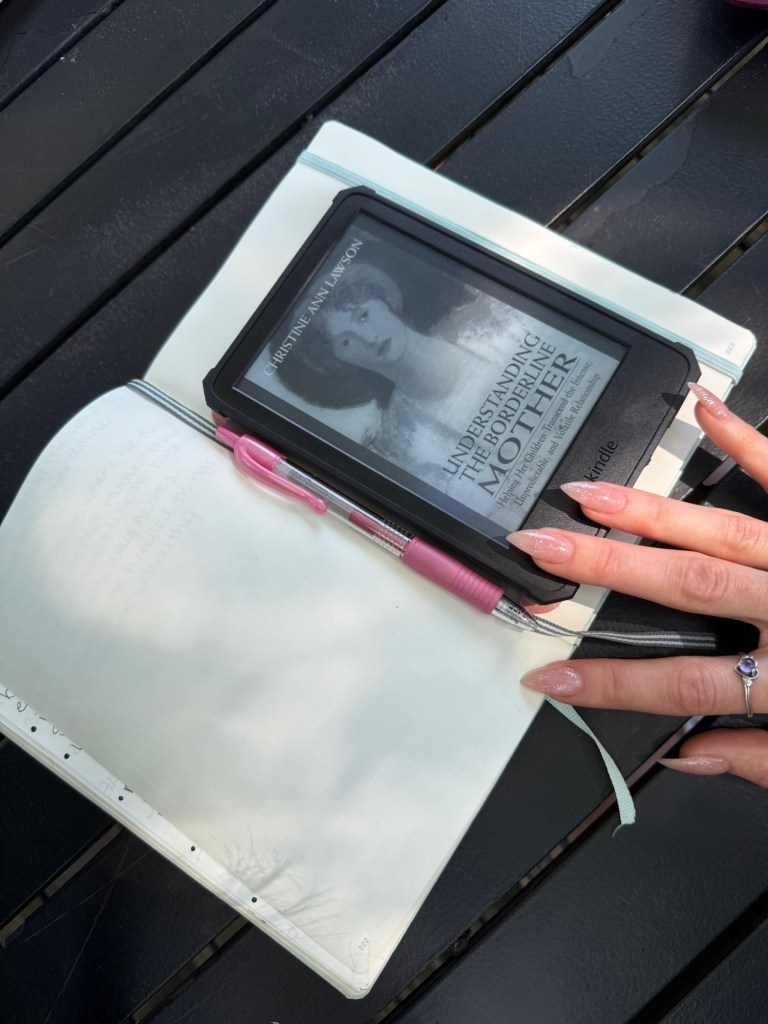
This book took me over five years to finish. Not because it was long or dense—but because it hurt. Some pages made my stomach turn. It dug up memories I had buried so deep, I forgot they existed. Things that were so wrong—and I knew they were wrong—but I ignored them to survive. Because acknowledging them would mean facing the reality that my own mother didn’t always have my best interest at heart. And that kind of pain is almost too much for a child to carry.
Worse, because mothers with BPD are often skilled at masking—appearing warm, selfless, or even charming in public—no one ever believes the child. You grow up in this warped emotional reality, desperate for someone to see it. But they don’t. And so you start to question yourself instead.
That’s what happens when mothers don’t heal before having children. Their pain becomes their lens. Their fear becomes their filter. And eventually, it’s all projected onto the child—until it becomes the child’s reality.
Reading Understanding the Borderline Mother didn’t just validate what I went through—it reminded me of something life-changing:
You are not your mother. You are not your upbringing. You are not your trauma.
Once you acknowledge that you are separate from your parents, their wounds, and the roles they cast you in, you can begin the process of reclaiming your truth.
That’s where healing starts. That’s where freedom begins.
Now that I’ve read this book cover to cover, I want to share what I’ve learned—not just about my mother, but about myself.
1. Borderline Personality Disorder Is Often Undiagnosed in Mothers
One of the most eye-opening parts of the book was learning just how many mothers may suffer from undiagnosed BPD. Dr. Lawson writes, “If researchers are correct in their estimate that approximately 6 million people in the U.S. suffer from BPD, the number of children living with borderline parents could be staggering.”
And yet, most go undiagnosed—especially mothers. Why? Because BPD is often masked behind high-functioning personas. Many people with BPD appear completely normal—loving, friendly, successful, even maternal—to the outside world. Meanwhile, behind closed doors, their children are subjected to emotional chaos.
My mother is diagnosed with Borderline Personality Disorder—but not until I was already an adult. The childhood damage was already done. Still, I admire her deeply for trusting me with that truth. Her diagnosis helped me understand her—and helped me release the guilt I carried for so long.
That said, understanding didn’t erase my anger. In fact, it made me even more angry for the child in me—who was innocent and needed a mother, not chaos. But through that anger, I found compassion. Today, I accept my mother for where she’s at, while fiercely protecting my peace, my boundaries, and my right to heal.
2. The Different “Faces” of a Borderline Mother Can All Exist Within One Person
Dr. Lawson outlines four major faces of the borderline mother: the Waif, Hermit, Queen, and Witch. While one of these may be more dominant, nearly every borderline mother embodies all four faces at different times.
- The Waif is helpless and overwhelmed, using guilt and victimhood to gain sympathy.
- The Hermit is fearful, critical, and controlling—obsessed with safety and perfection.
- The Queen craves attention, loyalty, and obedience, punishing independence or disagreement.
- The Witch is openly cruel, punishing, and rageful—emotionally or physically abusive.
These faces can flip instantly. One moment you’re being hugged, and the next you’re the enemy. That instability teaches children to walk on eggshells, never knowing who they’ll be dealing with.
And no matter what role the child plays, the borderline mother projects herself onto them. She cannot see her children as separate individuals with their own emotions and needs. She sees reflections—of her fears, failures, dreams, and wounds. Which means she cannot truly meet you where you are. And that lack of emotional attunement is devastating.
3. The Roles She Assigns to Her Children Are Deeply Damaging
Instead of nurturing her children based on who they are, the borderline mother often assigns them roles that serve her emotional needs. Dr. Lawson identifies three common ones:
- The Golden Child is idealized and expected to reflect the mother’s greatness.
- The Good Child is compliant and responsible—often acting as the emotional caretaker.
- The No-Good Child is blamed for everything and used as the family scapegoat.
These roles aren’t fixed. You can shift from golden to no-good overnight. Children are often pitted against each other, manipulated to compete or prove loyalty. It fractures sibling relationships, but worse—it fractures your identity. You grow up unsure of who you are without someone else’s approval.
4. Her Romantic Partners Often Play a Role in the Dysfunction
In Understanding the Borderline Mother, Dr. Lawson notes that many borderline mothers are drawn to men who lack strong boundaries or who reinforce their distorted view of reality. These men often become part of the dysfunction—sometimes unknowingly.
Some are emotionally unavailable. Some are passive and avoid conflict at all costs. Others fear the mother’s rage and go along with her to keep the peace. But no matter how well-meaning they may appear, the result is often the same: they fail to protect the child.
Instead of being a safe haven, the father figure may:
- Back the mother no matter what, reinforcing her narrative and making the child question their own reality.
- Disengage entirely, leaving the child emotionally abandoned and alone to navigate the chaos.
- Redirect blame, suggesting the child is “too sensitive,” “dramatic,” or “disrespectful” for expressing pain.
When I tried to speak up about what I was experiencing, I was often told things like:
“Don’t talk about your mom that way.”
“You know how she gets.”
“You’re making things worse.”
And just like that, I was silenced again.
These dynamics don’t just confuse you—they train you to doubt yourself, to prioritize others’ comfort over your truth, and to betray your own instincts.
The message is loud and clear: You’re the problem.
So you start to believe it.In doing so, they invalidate your experience and teach you to deny your reality. You’re forced to trust the very person who’s hurting you. And you grow up confused, hypervigilant, and ashamed of your truth.
5. The Chaos Wasn’t My Fault
When love and cruelty come from the same person, it scrambles your sense of self. I spent years trying to be “perfect” to earn safety. I went to church by myself. I swore I’d never lie. I tried to be so good she’d have nothing to criticize. But she always found something.
Eventually, I gave up. I started lying. Sneaking around. One extreme to the other—just trying to survive a reality where no version of me was ever enough.
This book helped me see it clearly:
I didn’t cause the chaos. I was responding to it the best I could. And that realization gave me the self-forgiveness I desperately needed.
6. Gaslighting Can Be Disguised as Kindness
Abuse doesn’t always look like yelling or slamming doors. Sometimes it sounds like “I love you.” Sometimes it ends in a hug.
After screaming, accusing, or punishing me, my mother would often want to “make up” within hours. She’d act like nothing happened, or worse—like it was somehow mutual. And I knew I had no choice but to go along with it.
So I’d say sorry too. I’d hug her. I’d comfort the very person who had just hurt me. And I’d push down my anger, my truth, and my needs—again.
It’s a mind game that teaches you to invalidate your own pain. But this book gave me the words to reclaim that truth. It helped me stop gaslighting myself—and start honoring the little girl who never got to be fully real.
7. Boundaries Aren’t Cruel—They’re Essential
Setting boundaries with a borderline mother often feels like betrayal. You’re conditioned to believe that your existence is an extension of hers—and that saying “no” is selfish, cruel, or ungrateful.
But the truth is, boundaries are the only way to have a healthy relationship with a BPD mother—if one is possible at all.
They’re not about punishing her. They’re about protecting yourself.
They’re how I stopped living in reaction mode and started creating space for peace, healing, and self-respect.
8. You’re Allowed to Grieve the Mother You Didn’t Get
There’s a specific grief in realizing your mother may never be who you needed her to be. A grief that doesn’t come from what happened—but from what didn’t.
Sometimes I resent the years I lost to trauma. I ache for the version of me that could’ve existed if my inner world had been nurtured instead of dismissed. But I remind myself—this journey made me who I am.
The fire shaped me.
The healing empowered me.
And the grief, while heavy, has also made space for compassion.
9. Breaking the Cycle Starts With Awareness
The cycle ends with the one who chooses to look inward.
Reading this book wasn’t just educational—it was transformative.
I cried.
I journaled.
I talked about it with my partner.
I even began applying tips from the book in real-time with my mother.
And it changed everything—especially how I see myself.
I began showing up differently in my relationships. I stopped absorbing other people’s pain. I stopped shrinking to avoid conflict. I stopped blaming myself for not being lovable enough.
I’m not perfect. But I’m present. And I’m healing—on purpose.
💬 Let’s Keep the Conversation Going
✨ Leave a comment and share something you’ve learned about yourself in your own healing
✨ Send this post to someone who might need clarity, comfort, or courage
✨ Bookmark this blog for more reflections on breaking cycles, reclaiming your identity, and coming home to yourself
You deserve peace. You deserve joy. You deserve a life that feels like yours.
Let’s keep healing—together.
Follow for more: icixcx.com
 INTERTWINEDIVINE
Leave a comment